
Coin Flip Betting Strategy: Probability-Based Approaches, Random Trading Strategies, and High-Risk Gambling Tactics
Authored by promoverspittsburgh.com, 18 Jul 2026
Fifty percent. That is the ceiling. No matter how a coin flip betting strategy is dressed up with charts, streaks, or clever staking patterns, the underlying probability never moves past even odds. Yet gamblers and, increasingly, traders keep searching for an edge inside a mechanism that is mathematically designed to have none. That tension between human pattern-seeking and pure randomness is what makes this subject worth examining closely.
The appeal isn't irrational, either. A coin flip strips away the noise of skill-based games and market analysis, leaving a stark binary outcome that feels almost meditative in its simplicity. Some platforms have leaned into that appeal directly, building entire game formats around it; for readers curious about how this translates into an actual wagering product, you can click here to see one example of the genre in action. What starts as curiosity about a simple 50/50 bet often turns into a deeper question: can any structured approach improve results, or is every method just superstition wearing a mathematical costume?
This piece works through the real mechanics of probability-based coin strategy, the surprising overlap between coin-flip logic and random trading strategy models used in finance, and the psychological traps that turn a harmless bet into a high-risk gambling habit. The goal is clarity, not false hope.
Understanding the Mathematics Behind Coin Flip Betting
Before evaluating any coin flip betting strategy, it helps to separate what mathematics actually guarantees from what people wish it guaranteed. A fair coin has no memory. Each flip is an independent event, and the probability of heads or tails resets to exactly 50% every single time, regardless of what came before.
The Law of Large Numbers vs. Short-Term Variance
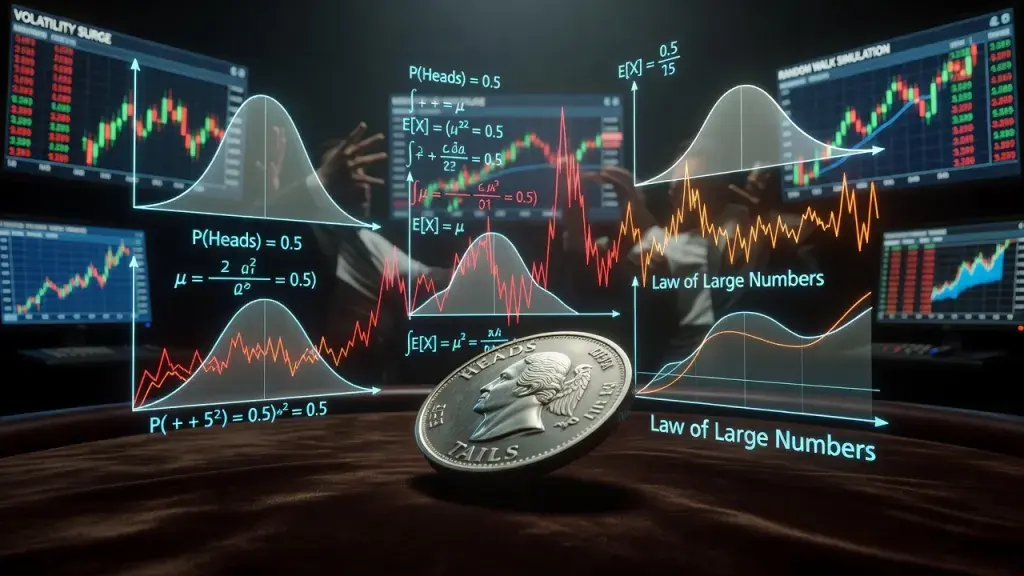
Over thousands of flips, the ratio of heads to tails will converge toward 50/50. But over ten or twenty flips, wild deviations are common and entirely expected. A run of seven heads in a row feels statistically alarming to a casual observer, yet it falls well within normal variance for a fair coin. Confusing long-term convergence with short-term predictability is the single biggest reasoning error in this space.
Why Independent Events Can't Be "Timed"
Independence means past outcomes carry zero information about future ones. There is no accumulated pressure pushing the next flip toward tails after a heads streak. Any probability-based coin strategy that claims to predict the next outcome from previous results is working from a false premise, no matter how convincing the pattern looks on paper.
The Gambler's Fallacy Explained
This is the formal name for the belief that a coin becomes "due" for a particular outcome after a streak. It has been documented in casino behavior for decades and remains one of the most persistent cognitive biases in wagering environments. Recognizing it in real time is harder than recognizing it in theory, which is precisely why it keeps costing people money.
Probability-Based Coin Strategy: Does It Actually Work?
Structured betting systems exist for coin flips the same way they exist for roulette, and they carry the same fundamental limitation: no staking pattern changes the underlying probability of the next event.
Fixed-Ratio Betting Models
A fixed-ratio approach means wagering a consistent percentage of a bankroll on every flip, regardless of prior outcomes. This doesn't improve the odds, but it does control the rate at which a bankroll can be depleted, which matters more than most bettors initially assume.
The Martingale System and Its Real Risks
Martingale betting doubles the wager after every loss, aiming to recover all previous losses plus a small profit on the eventual win. It sounds elegant. In practice, it requires unlimited bankroll and unlimited table limits, neither of which exist. A losing streak of ten flips, which is statistically unremarkable, would require doubling a bet ten consecutive times - a number that bankrupts almost every real-world bettor before the "guaranteed" win arrives.
Kelly Criterion Applications for Binary Outcomes
The Kelly Criterion calculates optimal bet sizing based on perceived edge and odds offered. Applied honestly to a true 50/50 coin flip with even payouts, Kelly correctly outputs zero - meaning there is no mathematically justified reason to bet at all, since there's no edge to exploit. Kelly becomes useful only when payout odds are skewed, such as promotional offers that pay slightly more than even money on one outcome.
Case Studies From Behavioral Economics
Research into decision-making under uncertainty consistently shows that people misjudge random sequences, expecting them to "look" more alternating than true randomness actually produces. This mismatch between intuition and statistics explains why so many probability-based coin strategy systems keep getting reinvented despite prior failures.
Random Trading Strategy: When Coin-Flip Logic Enters the Markets
The link between coin flipping and financial markets isn't just a metaphor. Some analysts have literally tested random trading strategy models - buying or selling based on a coin flip rather than analysis - as a benchmark against professionally managed portfolios.
Random Walk Theory in Financial Markets
Random walk theory argues that short-term price movements are largely unpredictable and resemble a sequence of independent steps, not unlike coin flips. This doesn't mean markets are identical to coin flips - they carry trends, cycles, and fundamentals - but short-term noise often behaves close enough to randomness that distinguishing skill from luck becomes genuinely difficult.
Backtesting a Coin-Flip Approach to Stock Picks
When researchers have pitted random stock selection against actively managed funds over multi-year periods, the random approach has frequently performed competitively, particularly after accounting for management fees. This doesn't validate randomness as wisdom; it highlights how much of active management's advertised skill may be indistinguishable from noise over shorter time horizons.
Why Traders Confuse Randomness With Skill
A trader who wins five trades in a row on genuinely random entries will often attribute the streak to insight rather than variance. This is the same cognitive trap gamblers fall into after a hot streak at the tables. The unpredictable investment strategy that "worked" last quarter may simply have been noise that hasn't reversed yet.
High-Risk Gambling Tactics: Separating Strategy From Recklessness
Some tactics marketed as strategy are, functionally, just aggressive risk-taking dressed in analytical language.
All-In Betting Psychology
Betting an entire bankroll on a single flip removes variance from the equation entirely - there's no long game to play, only one binary outcome. This appeals to people chasing quick recovery from losses, but it eliminates any benefit that comes from probability smoothing out over repeated trials.
Progressive Betting Under Pressure
Progressive systems that increase stakes after losses, similar to Martingale, feel logical in the moment because they promise recovery. Under real financial or emotional pressure, though, they tend to accelerate losses rather than reverse them, since the underlying win probability never actually improves.
Recognizing the Line Between Bold and Reckless
A useful distinction: bold risk-taking accepts a calculated downside within a plan; reckless risk-taking ignores the downside because the upside feels emotionally necessary. High-risk gambling tactics almost always fall into the second category once losses start accumulating.
- Setting a hard loss limit before playing, not during
- Treating each flip as an isolated event with no memory
- Avoiding bet-size increases driven by frustration rather than plan
Unpredictable Investment Strategy: Lessons From Coin Flip Logic Applied to Finance
Investors sometimes borrow coin-flip reasoning without realizing it, particularly when markets feel directionless.
Diversification as a Hedge Against Randomness
If short-term price movement resembles a coin flip, diversification becomes the rational response - spreading exposure across many "flips" so that no single random outcome determines the entire portfolio's fate. This is standard portfolio theory, but it's worth framing through the coin-flip lens because it clarifies why concentration risk is dangerous specifically in unpredictable conditions.
Algorithmic Trading and Randomized Entry Points
Some quantitative funds intentionally randomize entry timing within a broader strategy to avoid predictable patterns that other algorithms could exploit. This is a deliberate, engineered use of randomness - quite different from an amateur random trading strategy adopted out of indecision.
When Uncertainty Should Change Your Portfolio Allocation
Rising uncertainty typically calls for reduced position sizing and increased liquidity, not bolder bets. Treating heightened market unpredictability as a cue to gamble harder is the financial equivalent of doubling down after a losing streak - logically tempting, structurally dangerous.
Building a Responsible Framework for Coin Flip and Random-Based Betting
None of this means coin flips or randomness-based approaches are inherently harmful. The risk comes from misunderstanding what they can and cannot do.
Setting Bankroll Limits Before You Start
Decide the maximum acceptable loss before any wagering begins, not while emotions are running high mid-session. This single habit prevents most of the damage caused by progressive betting systems.
Using Probability Awareness to Avoid Emotional Traps
Internalizing that every flip is independent removes the emotional charge from streaks, win or lose. This awareness is the practical payoff of understanding probability-based coin strategy, even though it doesn't create an edge.
Knowing When a "Strategy" Is Just a Story You're Telling Yourself
If a system requires believing that randomness has patterns, memory, or momentum, it's not a strategy - it's a narrative built to justify continued betting. Genuine strategy in this context means bankroll management and expectation-setting, not outcome prediction.
Frequently Asked Questions
Can any betting system beat a truly fair coin flip over time?
No. Since each flip carries independent 50/50 odds, no staking pattern changes the expected long-term outcome. Systems can change how losses are distributed over time, but they cannot create an edge that doesn't exist.
Is the Martingale system ever safe to use?
It can be used briefly with a strict, predetermined stop point and a bankroll large enough to absorb several consecutive losses, but it carries real risk of rapid, severe losses during ordinary losing streaks. Most practitioners underestimate how common a ten-loss streak actually is.
How is a random trading strategy different from investing without research?
A deliberate random trading strategy is often used as a benchmark or a controlled experiment to test whether active analysis adds value beyond chance. Investing without research, by contrast, is usually driven by convenience or overconfidence rather than a structured comparison.
Why do winning streaks feel meaningful even when they're random?
Human pattern recognition evolved to find causes behind events, even in genuinely random sequences. This makes streaks feel like evidence of skill or momentum when they're statistically unremarkable variance.
What's the safest way to enjoy coin-flip style games without financial harm?
Set a fixed entertainment budget you're fully prepared to lose, treat each round as isolated, and stop once that budget is spent regardless of recent outcomes. Viewing it purely as entertainment rather than a potential income source keeps expectations realistic.
Does diversification actually help if markets behave like coin flips?
Yes, because spreading exposure across many independent or semi-independent outcomes reduces the impact of any single unpredictable result on the total portfolio. It doesn't eliminate randomness, but it prevents one bad "flip" from determining overall results.