
Baccarat Rules and Gameplay: Odds, Payouts, and Practical Strategy Tips
Authored by promoverspittsburgh.com, 25 Aug 2026
A shoe of eight decks. Three possible outcomes. And a house edge on one bet so slim that professional advantage players have spent decades trying to exploit it with card-counting techniques, mostly without success. Baccarat looks intimidating at first glance - the terminology alone (banker, punto, natural, tie) can make a newcomer hesitate at the table. But strip away the ceremony and you find one of the simplest comparing-card games in any casino, built on arithmetic a ten-year-old could follow.
That simplicity is exactly why baccarat has held its place at the high-limit tables of Macau, Monte Carlo, and Las Vegas for generations, while also becoming a staple of online casino lobbies where the stakes start at a dollar. The confusion most players face isn't the math - it's the sequence of decisions the game makes on their behalf. Third-card draws happen automatically according to fixed rules, and understanding why a hand freezes at two cards or draws a third is where most guides fall short. If you want a grounded answer to what is baccarat card game before going further, it helps to know that at its core it's a contest between two hands - Player and Banker - with the bettor simply predicting which one lands closer to nine.
This piece walks through the complete mechanics: how a round unfolds, what each payout actually returns, why the house edge varies so sharply between bets, and which strategy adjustments are grounded in real probability rather than table myth. No superstition, no invented systems - just the numbers and the decisions that follow from them.
Understanding Baccarat Rules from the Ground Up
Card Values and Hand Totals
Baccarat rules assign point values that differ from most card games. Aces count as one. Cards from two through nine retain their face value. Tens and all face cards - kings, queens, jacks - count as zero. When a hand's total exceeds nine, only the second digit counts. A hand of 7 and 8, for instance, totals fifteen on paper but counts as five at the table. This single mechanic explains nearly every strange-looking draw decision that follows.
The Two Hands: Player and Banker
Every round deals two hands, labeled Player and Banker regardless of who is physically holding the cards or dealing. Bettors wager on which hand will finish closer to nine, or on a tie between them. Nobody at the table, including the dealer, makes strategic choices about hitting or standing - the outcome is fully mechanical once the cards are dealt, which removes skill-based decision-making from the equation entirely.
The Natural Win Condition
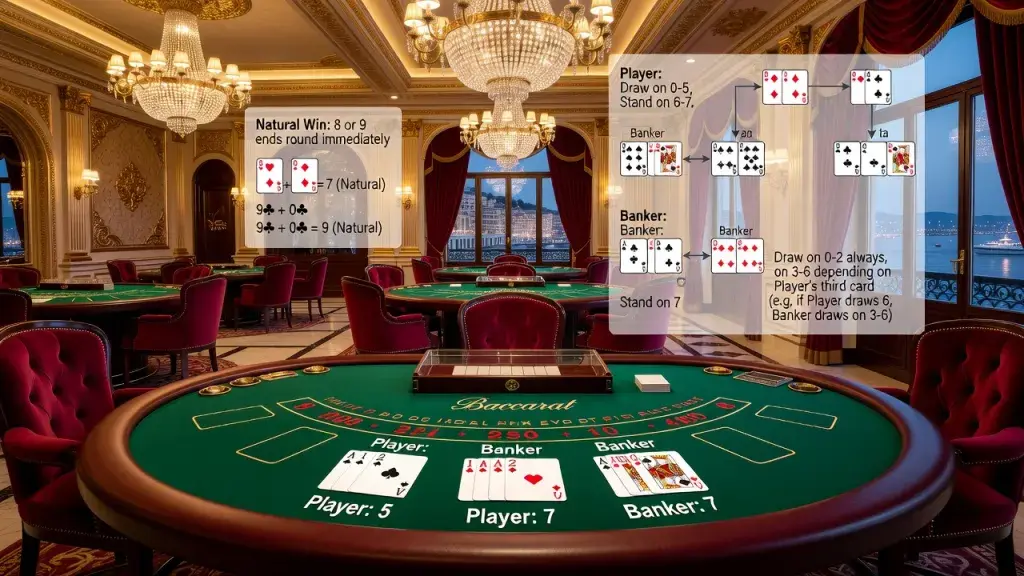
If either hand totals eight or nine on the first two cards, that's called a natural, and the round ends immediately - no further cards are drawn by either side. A natural nine beats a natural eight; if both hands show naturals of equal value, the round is a tie. This rule alone resolves a substantial share of hands before any drawing logic comes into play.
How Baccarat Gameplay Unfolds at the Table
Placing Bets Before the Deal
Before any cards appear, players choose one of three wagers: Player, Banker, or Tie. Some tables also offer side bets on pairs, but these carry a markedly higher house edge and are best treated as entertainment rather than value plays. Baccarat gameplay moves quickly compared to games like blackjack, since betting decisions happen only once per round.
The Dealing Sequence
Two cards go to the Player hand and two to the Banker hand, dealt from a shoe holding multiple decks - usually six or eight. Totals are revealed, and if neither hand qualifies as a natural, the game moves into its third-card phase according to a fixed drawing table baked into the rules.
The Third-Card Rule Explained
This is where most new players lose the thread. The Player hand draws a third card on totals of zero through five and stands on six or seven. The Banker's decision is more nuanced: it depends not just on the Banker's own total but on the value of the Player's third card, if one was drawn. For example, a Banker total of three draws against most Player third cards except an eight. A Banker total of six only draws if the Player's third card was a six or seven. These rules aren't arbitrary - they're calibrated to keep the house edge on the Banker bet lower than on the Player bet, which is precisely why a commission exists on Banker wins.
- Player total 0-5: draws a third card
- Player total 6-7: stands
- Banker total 0-2: always draws
- Banker total 7: always stands
- Banker total 3-6: draws conditionally based on the Player's third card
Breaking Down Baccarat Odds
Why Banker Has a Statistical Edge
Baccarat odds favor the Banker hand slightly, a direct consequence of the third-card drawing rules working in its favor more often than not. Over the long run, the Banker hand wins more frequently than the Player hand - a gap of roughly one percentage point that becomes meaningful across thousands of rounds. Casinos offset this advantage by charging a commission on Banker wins, which brings the effective house edge back into balance.
Comparing the House Edge Across Bets
The house edge on the Banker bet, after commission, sits close to 1.06%. The Player bet runs slightly higher, around 1.24%. The Tie bet, despite its tempting payout, carries a house edge that frequently exceeds 14%, making it the weakest bet on the table by a wide margin. These numbers explain why serious players almost universally avoid the Tie, regardless of how the shoe has been running.
How Deck Count Affects the Numbers
Fewer decks in the shoe shift the odds slightly, generally narrowing the gap between Player and Banker probabilities. Games dealt from a single deck or two decks are rare outside specialty tables, but where they exist, the house edge calculations move enough to matter for anyone tracking the math closely.
Baccarat Payout Structures Explained
Standard Payouts for Player and Banker
A winning Player bet pays even money - bet ten, win ten. A winning Banker bet also pays even money on paper, but the house deducts a standard 5% commission from the win, which is the mechanism that offsets Banker's statistical advantage. This commission is typically tracked on a marker at the table and settled at the end of a shoe or session rather than deducted instantly on every hand.
Tie Bet Payouts and Their Real Cost
Tie bets typically pay 8 to 1, occasionally 9 to 1 at certain tables, which sounds appealing next to even-money bets. But the payout doesn't come close to compensating for how rarely a tie actually occurs, which is why its house edge dwarfs the other two options. Anyone chasing the Tie bet for its payout size is trading long-term value for short-term excitement.
Commission-Free Baccarat Variants
Some casinos offer commission-free Banker betting, where the 5% cut is replaced by a rule that pays even money on most Banker wins except a specific total - often a winning Banker hand of six, which pays half. This restructuring keeps the house edge roughly similar while changing how winnings are calculated, and it's worth reading the table rules carefully before assuming commission-free means better value.
Practical Baccarat Strategy Tips
Betting on Banker Consistently
Given the odds, wagering on Banker more often than Player is the mathematically sound baseline. It won't guarantee winning sessions, but over a large sample of hands, it produces better expected outcomes than alternating bets based on hunches or perceived streaks.
Managing a Bankroll Without Chasing Losses
Setting a fixed session budget and a stop-loss point protects against the tempting but flawed instinct to increase bets after a loss to "catch up." Baccarat strategy tips that hold up under scrutiny always circle back to bankroll discipline rather than betting patterns, because no wagering sequence changes the underlying odds of independent hands.
Ignoring Patterns and Scorecards
Many tables display scorecards tracking recent Banker, Player, and Tie outcomes. These boards feed a common but mistaken belief that past results predict future ones. Each hand in baccarat is independent of the last; the shoe doesn't have memory, and streak-chasing based on a scorecard is not a genuine edge.
Avoiding High-Edge Side Bets
Pair bets, Dragon Bonus wagers, and other side markets carry considerably worse odds than the core three bets. They're structured for entertainment and higher variance, not for players trying to minimize the house edge over time.
Common Mistakes Players Make in Baccarat
Misreading the Commission System
New players sometimes assume the commission is deducted immediately from their chip stack, leading to confusion when it isn't. Understanding how and when commission is tracked prevents unnecessary disputes at the table.
Overvaluing the Tie Bet
The appeal of a large payout draws in players who underestimate how infrequently ties occur. Treating the Tie as a rare side bet for fun, rather than a core strategy, keeps expectations realistic.
Believing in Betting Systems
Progressive betting systems like Martingale get applied to baccarat frequently, but no sequencing of bet sizes changes the house edge on independent events. These systems can extend a winning streak's payout but equally accelerate losses during a downswing.
Frequently Asked Questions
Is Banker really the best bet in baccarat every time?
Statistically, yes - Banker carries the lowest house edge of the three main bets even after commission is applied. It won't win every hand, but across a large enough sample, it consistently outperforms Player and Tie in expected value.
Why does the Banker bet have a commission if it wins more often?
The commission exists specifically because the third-card drawing rules give Banker a built-in mathematical edge. Casinos apply the roughly 5% cut to bring the payout structure back toward balance, rather than letting Banker bettors profit from an uncorrected advantage.
Can I use card counting in baccarat like in blackjack?
Technically it's possible to track cards, but the effect on odds is far smaller than in blackjack because baccarat's outcomes depend on fixed drawing rules rather than player decisions. Most professional analyses conclude the edge gained isn't large enough to justify the effort for typical shoe sizes.
What's the difference between commission and commission-free baccarat tables?
Standard tables deduct roughly 5% from Banker wins to offset its statistical edge. Commission-free tables skip that deduction but usually pay a reduced amount - often half - on a Banker win with a specific total, keeping the house edge similar through a different mechanism.
Does the number of decks in the shoe change my odds significantly?
It shifts the numbers slightly, generally narrowing the gap between Player and Banker win rates as deck count decreases. The effect is measurable but small enough that most casual players won't notice a practical difference at standard six- or eight-deck tables.
Should beginners avoid side bets entirely?
Side bets like pairs or bonus wagers carry a much higher house edge than the core Player and Banker bets, so they're not suited to anyone trying to preserve their bankroll. They can add variety, but they shouldn't form the basis of a serious approach to the game.